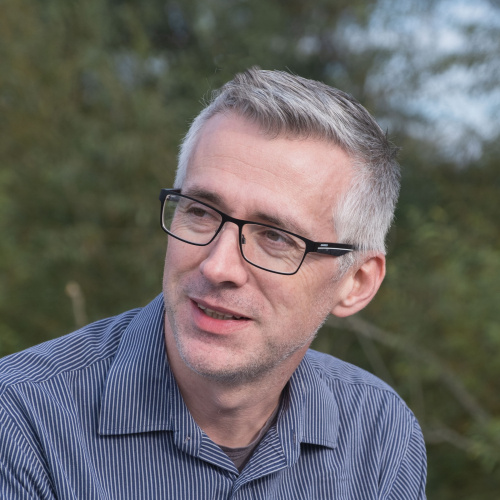
Building software on my own terms.
I founded Montala Limited in 2005. Now comprising 23 staff, Montala develops, supports and manages digital asset management systems based on our open source platform, ResourceSpace. In simple terms, it’s an advanced web-based media library that helps organisations manage and share their marketing and product assets efficiently.
My route into the web industry was fairly unconventional. I was originally studying Electronic and Software Engineering at Leicester University in the mid-1990s, but I became completely fascinated by the early internet after being introduced to it both by a friend with a Demon Internet modem and by my physics teacher at college. At the time there were no formal courses in web development, but it was obvious to me that something big was starting.
In truth, I spent far more time exploring the web and doing small freelance projects than I did on my degree. My interest had shifted to this new world of online technology. After the first year, I applied for any internet-related job I could find.
From converted barns to corporate systems.
In 1996 I joined Domino Systems, one of only a handful of UK web agencies at the time. We were a tiny team of seven working out of the top half of a converted barn on a farm in Oxfordshire. It was informal, intense, and hugely formative. We were essentially hobbyists who had somehow found a way to get paid for what we loved doing.
I owe that early break to Carl Christensen, the entrepreneur who built Domino and was willing to take a chance on enthusiastic young developers when very few people had real-world web experience. He sadly passed away in 2025, but his willingness to back raw enthusiasm over credentials had a lasting impact on me.
After Domino I spent a short period working on early online initiatives at WH Smith, including a Java-based social quiz game called “Dr Know” that even resulted in at least one couple meeting and later marrying through the platform, quite unusual for the time. However, I quickly realised that large corporate environments weren’t where I did my best work. The small Internet Bookshop team I had joined had been recently acquired by WH Smith and was being merged into the wider WH Smith structure, and the pace and culture changed dramatically, so I moved back into the higher energy agency world.
I joined SP New Media in Wantage as Technical Manager, where I built and led a development team and created a content management system called Varius. The goal with Varius was to bring designers, developers and content teams into a single unified workflow so projects could move faster without teams waiting on each other. The system later became a significant factor in SP New Media being acquired by XKO Software, a publicly listed company with over 600 staff.
The period that followed was the most difficult of my career. After the dot-com downturn in the early 2000s, XKO consolidated operations and closed the Wantage office. I was responsible for making redundant many of the people I had personally recruited over the previous two years, something I found extremely tough and which left a lasting mark on how I think about hiring and growth.
The jump in 2005.
By 2005, facing a more corporate structure and an unwelcome commute, I decided to go it alone and formed Montala. At the time it felt very much like jumping off a cliff. I had just had my first daughter, and although I was 27 and perhaps less risk-aware than I might be today, it was still a financially uncertain move.
Initially Montala was simply a vehicle to keep me employed doing work I enjoyed, with the flexibility to support family life and without the pressure of corporate oversight. Early projects included substantial government-related systems such as the UK Radon search platform (still largely running as I originally built it), a learning provider accreditation system for Jobcentre Plus, and a National Lottery grant application service - all delivered as a one-person consultancy.
There was even a moment early on when Montala very nearly didn’t exist. While still working solo, before ResourceSpace, I accepted a permanent role with one of my customers. After three days in what felt like a very corporate environment, I realised I’d made a mistake and returned to independent work. It was a close call.
A project that became the business.
ResourceSpace began almost as just another project. The opportunity came via Hugh Wallace, a former colleague from SP New Media who had moved to Oxfam as Head of New Media. Oxfam had been struggling to find a Digital Asset Management system that didn’t cost upwards of £100,000 per year, which we felt was excessive for what was needed. Together with Neale Hall, I built an initial version of ResourceSpace for Oxfam for a one-off cost of around £25,000, with modest ongoing support.
At the time, it was a fairly focused system that did exactly what Oxfam needed - no more, no less. I certainly didn’t expect it to become the core of my business. However, because Oxfam released it as open source, adoption began to grow organically and soon it was matching the functionality of commercial systems. Other charities such as ActionAid, Save the Children and Plan International came on board, and over time I began to realise just how widely it was being used across the NGO sector and beyond.
Growth was gradual and, if I’m honest, slower than it might have been because I was initially very cautious about hiring after my earlier experience at XKO. Montala’s first employee joined in 2010, followed by our first office and a small team in 2013. Even then, ResourceSpace only became our near-exclusive focus much later, around 2018.
Today ResourceSpace is used by around 500 supported organisations with more than 200,000 users on their systems, and we estimate there are roughly 2,000 deployments worldwide when including unsupported open source installations.
In 2018 Montala was awarded a Royal Warrant - a recognition that meant a great deal to me personally and to the team. Having such a respected institution recognise the quality of our work felt like a significant milestone and gave the business additional credibility.
Simple systems, fair structures.
Over time my focus has shifted from being involved in everything to building a leadership structure that works well without me in the middle of it. I am now one of two directors and there are three elected trustees above us. My role is much more about ensuring the overall system functions well than managing individuals day to day.
My technical philosophy has remained fairly constant throughout my career: keep things simple, build the minimum viable solution first, and iterate in small phases based on real-world use. I have a strong dislike of over-engineered systems and of adopting fashionable technologies without a clear cost–benefit case. In my view, stability and longevity matter far more to customers than chasing the latest trend.
Ethically, my thinking has evolved over time. While Montala wasn’t founded explicitly as an ethical business, my long-standing interest in environmental issues, early electric vehicle adoption, and a general belief that companies should ultimately benefit their workforce led us to pursue B-Corp certification and, in 2020, transition to 100% employee ownership. That move aligned the company structure more closely with my personal values and also reduced the personal financial concentration I had in the business.
Today, 10% of Montala’s profits go to charity (a total of nearly half a million as of 2026), and the employee ownership model ensures the team directly benefits from the company’s success. My leadership style is generally quite laid back, but I care deeply about fairness and about continually improving what we do for both staff and customers.
Looking back, the decision I’m most glad I made was to go it alone in 2005. It gave me the freedom to build something on my own terms and, hopefully, to make a positive difference along the way. If I have any regret, it’s that I was perhaps too cautious about growth in the early years... the experience at XKO left its mark, but overall the journey has worked out far better than I could have predicted at the time.